
Beyond the Hype: Navigating the Real AI Workforce Transformation
If you have recently scrolled through business news, you have likely encountered dire warnings about the future of work. Headlines proclaim an AI-driven “apocalypse” or a “bloodbath” for white-collar jobs, painting a picture of mass obsolescence. While this narrative is certainly eye-grabbing, it offers little practical guidance for leaders on the ground. The reality is far more nuanced. Instead of widespread job elimination, we are witnessing a fundamental reallocation of tasks, a reshaping of roles, and a disruption of traditional career paths. The central challenge for organizations today is not managing mass redundancy, but strategically building a workforce that is truly AI-ready—one equipped with both the technical skills to leverage AI and the adaptive human skills to navigate its ripple effects. This article provides a blueprint for moving beyond the hyperbole to cultivate a coherent, future-proof talent strategy.
The AI Fragmentation Crisis: Why Adoption Outpaces Integration
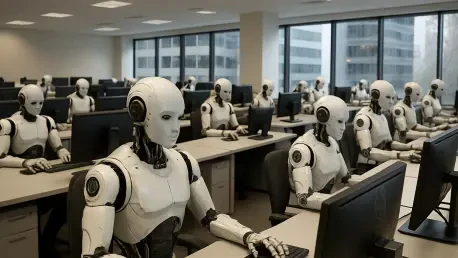
The current state of AI in the enterprise can be described as everywhere and nowhere at once. While AI adoption is now nearly universal, most organizations remain in the early stages of scaling and integration. Teams have scattered tools, pilot programs, shadow workflows, and vendor-led demos, but these disparate elements rarely combine into a cohesive organizational capability. This gap between high adoption and low integration has created the next major disruption: the AI fragmentation crisis. Every function—from sales and marketing to engineering and product—is learning AI at its own pace, using its own language, and setting its own expectations. The result is a fractured workforce with no shared AI baseline, creating inefficiencies and strategic vulnerabilities. This is the new hiring challenge: companies do not lack AI tools; they lack AI coherence.
Decoding the New Talent Equation: Skills, Signals, and Strategy
From Credentials to Capability: Why Resumes and Degrees Are Failing Us
To build a coherent AI workforce, we must first recognize that our traditional methods for identifying talent are broken. For decades, organizations have relied on proxies like university degrees, job titles, and polished resumes to gauge a candidate’s competency. This system worked in a slower, more predictable labor market where a degree signaled discipline and a well-written cover letter indicated genuine effort. However, this signaling system has collapsed. Generative AI has commoditized these traditional signals, making it possible to produce flawless applications in seconds and devaluing what were once meaningful indicators of skill and motivation. Simultaneously, the rapid pace of technological change means a degree from five or ten years ago reveals little about a candidate’s ability to adapt and work with today’s AI tools. To navigate this new reality, leaders must pivot from trusting what candidates claim on paper to verifying what they can actually do.
The Rise of Dual Fluency: Marrying Technical Prowess with Human Adaptability
The solution to the coherence crisis lies in cultivating what can be called “Dual Fluency”—the synergistic combination of hard technical skills and adaptive human skills. This is the new baseline for an effective AI-ready employee. The first component is fluency in AI tools: understanding how to choose them, evaluate their output for correctness, establish operational guardrails, and build resilient workflows. The second is fluency in adaptive human skills: demonstrating rapid learning agility, applying systems thinking to complex problems, and adeptly translating new technological capabilities into tangible business operations. While most teams possess fragments of both, very few have a shared foundation of dual fluency across all roles and levels. Closing this gap is the single greatest workforce opportunity for organizations aiming to lead in the age of AI.
The Great Rebalancing: Confronting the ‘Barbell’ Workforce
The labor market is not merely drifting toward change; it is snapping into a new shape. Economists have long pointed to the emergence of a “barbell” workforce distribution, characterized by growth in high-skill, high-autonomy roles at one end and low-skill, automation-compatible service jobs at the other, with a significant hollowing out of the middle. AI is dramatically accelerating this trend by absorbing the routine cognitive work—such as analysis, coordination, reporting, and documentation—that once constituted the core of mid-level professional roles. This creates a critical fault line that organizations must navigate. The traditional career ladder, which guided employees from junior to mid-level to senior positions, is breaking down as the middle rungs disappear. This necessitates a complete rethinking of career progression and talent development.
Forging the Future: A New Playbook for Skills-First Talent Management
As old structures crumble, new strategies must emerge. The future of talent management lies in a robust, skills-first approach that prioritizes demonstrable capability over traditional credentials. This requires a new playbook focused on synthesizing rich candidate data from multiple sources. Innovations will include using objective skills tests to verify hard skills like “Prompt Engineering” instead of relying on self-reported claims, and deploying behavioral and cognitive assessments to measure adaptive traits like problem-solving and emotional intelligence. This data-driven process will be complemented by structured interviews that probe for behavioral competencies across both technical and human skill sets. Consequently, career progression will be redefined, moving away from a linear climb and toward creating pathways that develop judgment, cross-functional fluency, and adaptability early in an employee’s journey.
Your Action Plan: Implementing a Dual-Fluency Talent Strategy
The path forward requires a decisive shift in mindset and process. The major takeaway is clear: the AI “jobpocalypse” is a distraction from the real work of strategic workforce development. To build a team that is truly ready, leaders must implement an actionable, dual-fluency talent strategy. First, evolve beyond the resume by adopting a multi-faceted evaluation process that combines skills testing, behavioral assessments, and structured interviews to create a holistic and fair picture of every candidate. Second, deliberately invest in nurturing junior talent. Gen Z, as digital natives, often possesses the raw potential for dual fluency. Use skills-based assessments to identify these high-potential individuals, even if their backgrounds are unconventional. Finally, rethink career pathways to cultivate the adaptability and critical judgment needed to thrive in a world where the “middle” of the workforce is constantly being redefined.
Building for Tomorrow: Hire for Coherence, Grow for Potential
There will be no AI bloodbath, but a profound transformation is already underway. As technology reshapes industries, the defining challenge for leaders is to build a workforce that moves in concert with technological acceleration, not against it. The work ahead is not about defending an old system but about building a new one centered on capability and potential. For any organization aiming to thrive, the mandate is clear: stop hiring for the past. To build a workforce that is coherent, adaptable, and truly prepared for the AI age, you must look beyond the paper. You must test for the dual fluency of technical capability and human adaptability. When you hire for real skills and grow for potential, you create a resilient organization capable of navigating the future with confidence.