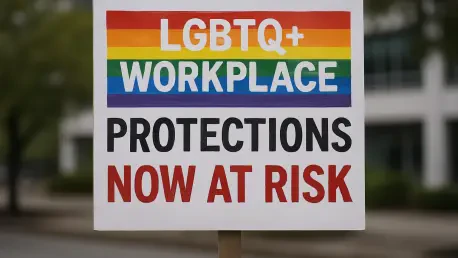

A sharp divide over the scope of federal anti-discrimination law has erupted into a public battle as a coalition of former high-ranking government officials openly challenges a recent maneuver by the U.S. Equal Employment Opportunity Commission (EEOC). This group, comprised of former EEOC and Department of Labor leaders known collectively as EEO Leaders, has issued a forceful condemnation of the current commission’s formal request to the White House to rescind crucial anti-harassment guidance established during the previous administration. At the heart of this escalating conflict are the specific provisions within the guidance that extend workplace protections to LGBTQI+ individuals, a move the current EEOC leadership aims to reverse. The controversy signals a significant ideological clash over the interpretation and enforcement of civil rights, placing the stability of recently solidified workplace protections in a precarious position and raising questions about the future direction of federal oversight in employment law.
A Clash of Ideologies Over Workplace Rights
The effort to dismantle the existing guidance is being championed by EEOC Chair Andrea Lucas, who has articulated a clear ideological opposition to its core tenets. On December 29, the agency officially petitioned the White House for approval to rescind the guidance, an action Lucas frames as essential to “protect the sex-based privacy and safety needs of women” and to systematically “[roll] back the Biden administration’s gender identity agenda.” Having previously voted against the 2024 guidance, her objections are deeply rooted in its interpretation of harassing conduct. Specifically, she targets the guidance’s assertion that denying an employee access to workplace facilities, such as bathrooms, that align with their gender identity constitutes harassment. Furthermore, she contests the classification of repeated and intentional misuse of an employee’s pronouns as a form of prohibited conduct. In her view, the guidance was “fundamentally flawed” for purportedly ignoring “biological reality,” infringing upon the free speech and belief systems of other employees, and effectively eliminating the existence of single-sex facilities in the workplace.
In stark contrast, the EEO Leaders interpret the commission’s actions not as a simple policy correction but as a calculated and politically motivated maneuver. They characterized the rescission request as “yet another salvo in this Administration’s prolonged attack on LGBTQI+ people,” suggesting it is part of a much broader and more systematic campaign. From their perspective, this move is not an isolated incident but a key component of a larger strategy by the Trump administration to deliberately weaken the federal government’s ability to enforce anti-discrimination laws. The former officials argue that the attempt to nullify the guidance is a deliberate effort to create confusion and obscure what has become a clear legal consensus: that harassment and discrimination based on an individual’s sexual orientation or gender identity are prohibited under federal law as forms of sex-based discrimination. This view casts the current EEOC’s actions as a regressive step that threatens to undermine years of legal precedent and progress in civil rights enforcement.
Procedural Disputes and Legal Contradictions
Beyond the ideological disagreements, the former officials have raised serious procedural objections that question the legality of the EEOC’s approach. A primary point of contention is the commission’s decision to submit its rescission request to the White House as a “final rule.” This classification is critical because it allows the agency to circumvent the standard public notice and comment period, a foundational step in federal rulemaking that ensures transparency and allows stakeholders—including employers, employees, and civil rights organizations—to provide input. The EEO Leaders emphasize that this very process of public engagement was integral to the development and implementation of the original 2024 guidance. By forgoing this step, they argue, the current commission is not only silencing public discourse on a matter of significant national importance but is also avoiding the scrutiny and accountability that come with a transparent regulatory process, a move they see as a deliberate effort to fast-track a controversial policy change.
The procedural concerns were compounded by what the former officials identified as a glaring legal inconsistency in the commission’s own recent statements. The EEO Leaders pointed to a February 2025 court filing in which both the Trump administration’s Department of Justice and Chair Lucas herself had explicitly described the anti-harassment guidance as “significant.” This designation, under administrative law, carries substantial weight, as any rule deemed “significant” legally requires the regulating agency to follow the full notice and comment procedures for any subsequent revision or rescission. The attempt to now treat the rollback as a simple final rule stood in direct contradiction to their own prior legal position. This inconsistency became a central argument for critics, who contended that the agency was attempting to ignore its own legal assertions to achieve a policy goal, an action that raised profound questions about the commission’s commitment to lawful administrative procedure and the integrity of its regulatory actions.