
Sofia Khaira stands at the forefront of the modern workplace evolution, serving as a dedicated specialist in diversity, equity, and inclusion. With a career built on helping organizations navigate the complexities of talent management, she has become a vital voice for businesses striving to balance competitive performance with equitable internal cultures. As the legal landscape surrounding federal contracts shifts under the weight of new executive mandates, her expertise provides a necessary bridge between high-level government policy and the day-to-day realities of corporate operations. In this discussion, we explore the intensifying legal battle over federal DEI restrictions and the profound constitutional questions currently sitting before a Maryland judge.
How do the current legal challenges against the executive order reflect the specific dilemma federal contractors now face regarding their diversity initiatives?
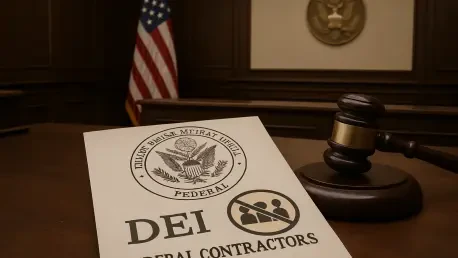
The administration has effectively backed federal contractors into a corner where they must choose between their financial survival and their core organizational values. By issuing the executive order on March 26, 2025, the government has mandated that these entities include specific clauses in their contracts that restrict what the administration labels as “racially discriminatory DEI activities.” This creates an impossible bind for businesses that have spent years building inclusive cultures only to be told they must now sign away their freedoms of speech and association to keep their federal partnerships. With a looming deadline of July 24 for agency heads to ensure compliance, the pressure on these organizations is reaching a boiling point. The feeling on the ground is one of deep uncertainty as firms realize that if they do not comply, they risk the immediate cancellation of their contracts and the loss of significant revenue streams.
What are the primary constitutional arguments being raised by the coalition of diversity officers and academic associations in this latest lawsuit?
The legal arguments brought forward by the coalition, which filed its lawsuit on April 20, are rooted in the fundamental protections of the 1st and 5th Amendments. The plaintiffs argue that this executive order acts as a “gag rule” dressed up as a mandatory contract clause, unconstitutionally limiting the ability of private organizations to speak freely about race and systemic discrimination. There is also a strong emphasis on the Administrative Procedure Act, with the coalition suggesting that the administration has overstepped its regulatory authority in a way that will cause irreparable harm. It is a high-stakes battle because the plaintiffs are asking the court for a preliminary injunction to halt these requirements before the July 24 deadline. For many involved, this isn’t just a technical dispute over contract language; it is a fight to protect the right of minority-owned businesses to participate in the federal marketplace without being forced to abandon their advocacy for equity.
Given the previous legal history involving the 4th U.S. Circuit Court of Appeals, how does the coalition plan to overcome past hurdles regarding legal standing?
Navigating the judicial system has been a difficult road for these groups, especially after the 4th U.S. Circuit Court of Appeals reversed a previous injunction this past February. In that instance, the court determined the plaintiffs lacked standing to challenge a provision that required agency heads to prepare reports on “illegal” DEI programs. This new legal push is designed to address those procedural hurdles by highlighting the direct, immediate impact of the March 26 executive order on current contracts and subcontracts. By focusing on the tangible threat of contract cancellation and the “impossible bind” it creates for direct business operations, the coalition is attempting to prove a more concrete injury. They are emphasizing that this is no longer about hypothetical reports, but about active mandates that force businesses to change their internal speech or face financial ruin.
In what ways does this executive order specifically threaten the viability and growth of minority-owned businesses within the federal contracting space?
For minority-owned businesses, the stakes of this executive order are particularly high and, frankly, quite emotional. These enterprises often lead the way in DEI efforts because those initiatives are central to their mission and their ability to recruit talent from underrepresented communities. When an attorney involved in the case describes this as a demand for these businesses to trade their First Amendment rights for fair access to federal contracts, it highlights a very real barrier to entry. Organizations like the National Association of Minority Contractors are concerned that if they are forced to stop their DEI activities, they will lose the very tools that allow them to compete in a historically lopsided market. There is a sensory weight to this shift—the feeling of a closing door for firms that have only recently gained a foothold in large-scale government projects.
What is your forecast for the future of federal DEI initiatives if the court declines to grant the preliminary injunction requested by the coalition?
If the court does not intervene before the July 24 compliance deadline, I expect to see a significant chilling effect across the entire federal supply chain. We will likely witness a wave of contract renegotiations where businesses are forced to choose between staying silent or losing millions in government work. This could lead to a fragmented market where the most principled organizations exit federal contracting altogether, leaving a void in innovation and diversity that will be hard to fill. Long-term, the legal battle will almost certainly escalate toward the Supreme Court, as the conflict between executive power and constitutional speech rights remains unresolved. Ultimately, the next few months will determine whether DEI remains a standard business practice or becomes a legal liability for anyone doing business with the United States government.