
The configuration of a worker’s body relative to their surroundings—such as a hand positioned near a moving gear—defines the thin line between safety and a catastrophic accident. In the modern industrial landscape of 2026, where efficiency often drives operational pace, the risk of human error remains a persistent shadow over factories, construction sites, and logistics hubs. While traditional surveillance systems have existed for decades, their utility was long hampered by the limitations of human observation, as safety officers cannot maintain perfect vigilance across every square foot of a facility simultaneously. This gap in oversight led researchers E. Jyotsna and T. Jarin to develop CAT-Net, a specialized Coordinate Attention Transformer Network designed to redefine how machines interpret human activity. By moving beyond simple motion detection, this architecture seeks to understand the context of every gesture, providing a proactive layer of protection that bridges the divide between visual data and actionable safety intelligence. The research, which found its footing in the study of complex spatio-temporal features, represents a significant shift toward automated, real-time behavioral analysis that anticipates danger rather than merely recording it after the fact.
Innovative Architecture for Visual Recognition
Integrating Core Technologies for Enhanced Detection
The structural integrity of CAT-Net relies on a sophisticated fusion of deep learning components, beginning with the implementation of Convolutional Neural Networks (CNNs). These networks function as the primary visual processors, scanning high-definition video feeds to identify the fundamental elements of a workplace environment, such as personnel, heavy machinery, and restricted zones. Unlike rudimentary sensors, a CNN can distinguish the subtle difference between a stationary pallet and a moving forklift by analyzing pixel-level features across successive layers. In a high-stakes industrial setting, this initial stage of processing is essential for establishing a baseline understanding of the scene. By extracting these spatial features, the system builds a comprehensive map of the workspace, ensuring that the AI recognizes not just that objects exist, but precisely what they are and how they are oriented within the frame. This foundational step is critical for any system tasked with monitoring human behavior in environments where a single misidentified object could lead to a failure in safety protocols.
Building upon the visual data captured by the CNN, the researchers introduced a Coordinate Attention mechanism to refine the system’s spatial precision. Traditional attention models often struggle with maintaining the exact location of features within a complex image, frequently losing track of positional context in favor of general recognition. The CA mechanism in CAT-Net addresses this by embedding horizontal and vertical coordinate information directly into the feature maps. This allows the system to monitor the exact proximity of a worker’s limbs to hazardous equipment with unprecedented accuracy. For instance, in a 2026 manufacturing plant, the difference between a technician performing routine maintenance and one entering a high-voltage danger zone is measured in inches. By prioritizing these spatial dependencies, CAT-Net ensures that its alerts are based on precise physical interactions rather than vague approximations. This level of granularity is what enables the system to function as a reliable safety guardian, capable of identifying high-risk configurations that would otherwise be invisible to less sophisticated automated monitoring tools.
Analyzing Time and Sequence with Transformers
While understanding the spatial layout of a scene is vital, workplace safety is equally dependent on the temporal dimension of human activity. Actions are rarely static; they are sequences of movements that unfold over seconds or minutes, and a single frame often lacks the context to determine if a behavior is dangerous. To capture this chronological narrative, CAT-Net utilizes Transformer encoders, a technology originally pioneered for natural language processing but now adapted for video analysis. Unlike older recurrent architectures that often suffered from memory loss when processing long video clips, Transformers employ a self-attention mechanism that evaluates all frames in a sequence simultaneously. This allows the AI to maintain a constant “thread” of understanding, linking an initial movement at the start of a task to the eventual outcome. By treating a video feed as a continuous story rather than a collection of snapshots, the system can identify deviations from standard operating procedures that might signal an impending accident or a lapse in safety discipline.
The integration of Transformers allows CAT-Net to recognize the subtle nuances of intent and progression in worker behavior. For example, a worker lifting a heavy crate might appear safe in any single frame, but when analyzed as a sequence, the AI can detect improper posture or a lack of team coordination that could lead to chronic injury or a sudden fall. This temporal depth is particularly important in 2026, as industrial processes become increasingly complex and require multi-step safety validations. The Transformer encoders provide the necessary computing power to model these long-range dependencies, ensuring that the system understands the “why” and “how” of an activity rather than just the “what.” This comprehensive view of time-based data transforms video monitoring from a passive recording tool into an active diagnostic system, capable of flagging irregular movement patterns before they reach a critical threshold. By synthesizing these temporal insights with precise spatial coordinates, the architecture achieves a holistic understanding of workplace dynamics that was previously impossible.
Performance Results and Industrial Impact
Validating Accuracy Across Diverse Environments
To ensure that CAT-Net could perform reliably outside of controlled laboratory conditions, the researchers subjected the model to rigorous testing using a wide array of datasets. These benchmarks included everything from routine clerical activities in an office setting to high-intensity operations on a factory floor. The goal was to prove that the hybrid architecture of CNNs, Coordinate Attention, and Transformers could generalize its learning across different visual contexts. The results were remarkably consistent, with the system demonstrating a high degree of accuracy in identifying both safe and unsafe behaviors regardless of the background complexity or the specific task being performed. This versatility is a major milestone for industrial AI, as it suggests that a single, robust model can be deployed across various sectors of an organization without the need for extensive, site-specific retraining. By outperforming existing state-of-the-art models in these tests, CAT-Net established itself as a leader in the next generation of occupational health and safety technologies.
The reliability of these results is particularly relevant for the 2026 industrial sector, where the margin for error in automated systems has reached an all-time low. One of the primary advantages observed during testing was the system’s ability to minimize false negatives, which are instances where a legitimate hazard goes undetected. In safety-critical environments, such a failure can have devastating consequences. By successfully merging detailed spatial features with long-range temporal sequences, CAT-Net provided a more stable and dependable analysis than its predecessors. This performance was not just a result of better hardware but a direct consequence of the innovative way the system prioritizes information. The dual-path processing ensured that even subtle cues, like a worker momentarily forgetting to engage a safety latch, were captured and flagged. This level of consistency provides the confidence necessary for facility managers to integrate AI-driven monitoring into their core safety strategies, knowing that the system can handle the unpredictable nature of human movement in a busy workplace.
Enhancing Operational Standards and Preventative Care
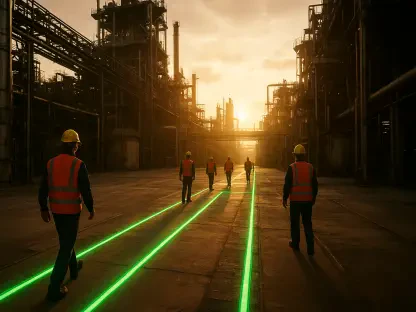
The practical impact of CAT-Net extends far beyond the immediate prevention of acute accidents, offering a comprehensive tool for improving long-term operational standards. One of the most immediate applications is the automated monitoring of personal protective equipment (PPE) compliance. The system can be programmed to verify that every person entering a specific zone is wearing the required helmet, high-visibility vest, and safety glasses. This eliminates the need for manual spot checks and ensures a constant, 100% compliance rate that significantly reduces the risk of injury. Furthermore, by analyzing the physical movements of workers over extended periods, the AI can identify ergonomic risks that might lead to musculoskeletal disorders. By highlighting repetitive motions or awkward lifting techniques, the technology allows companies to redesign workflows and provide targeted training to employees, fostering a culture of preventative care that prioritizes the long-term well-being of the workforce.
In the context of 2026 automation trends, where humans and robots increasingly work in shared spaces, CAT-Net provides a vital safety bridge. The presence of collaborative robots, or “cobots,” requires a monitoring system that can accurately predict human intent to prevent collisions. Because the AI understands the sequence of a worker’s actions, it can anticipate where that person is likely to be in the next few seconds, allowing the robotic systems to adjust their speed or trajectory accordingly. This seamless interaction is essential for maintaining productivity while ensuring that the physical proximity of machines does not pose a threat to human life. By serving as an intelligent intermediary, the technology enables a higher degree of synchronization between biological and mechanical actors. This collaborative safety model represents the future of high-tech manufacturing, where the objective is not just to isolate humans from machines, but to create an environment where both can operate together in a space that is monitored and secured by a tireless digital observer.
Practical Implementation and Future Considerations
Navigating Deployment Realities and Technical Refinement
Transitioning a highly advanced AI system like CAT-Net from a successful research project into a daily operational tool requires addressing several real-world environmental challenges. Industrial sites are often far from the pristine conditions of a computer vision lab, featuring varying lighting levels, dense steam, dust, and numerous occlusions that can block a camera’s line of sight. To be truly effective in a 2026 industrial environment, the system must remain robust under these stresses, maintaining its accuracy even when a worker is partially obscured by equipment or moving through a dimly lit corridor. The researchers highlighted the need for continuous refinement in how the model handles these edge cases, ensuring that the Coordinate Attention mechanism can still pinpoint locations when visual data is degraded. Future updates will likely focus on enhancing the system’s resilience, perhaps by incorporating infrared data or multi-angle camera feeds to provide a redundant layer of visual information that can bypass environmental obstacles.
Another critical hurdle in the deployment of such systems is the management of “alarm fatigue,” a phenomenon where safety officers become desensitized to alerts because of a high frequency of false positives. If an AI flags every minor, non-threatening deviation as a crisis, the human responders may eventually begin to ignore the system altogether, potentially missing a genuine emergency. To prevent this, the deployment of CAT-Net must be accompanied by careful calibration of its sensitivity thresholds, ensuring that it distinguishes between a trivial breach of protocol and a high-risk behavior. This requires a deep understanding of the specific operational context of each facility, where safety parameters are tailored to the actual risks present on-site. By refining the logic that triggers an alert, developers can ensure that when the system speaks, it is heard and acted upon. This balance between sensitivity and specificity is what will ultimately determine the success of AI-driven safety tools in the eyes of the workers and managers who rely on them daily.
Establishing Ethical Frameworks for Intelligent Surveillance
As the capabilities of AI-driven monitoring expand, the conversation around workplace surveillance has shifted toward the necessity of robust ethical and governance frameworks. The implementation of a system that “watches” and analyzes every movement of an employee naturally raises concerns regarding privacy, data security, and the potential for the technology to be misused for punitive purposes rather than safety. For CAT-Net to be accepted by the workforce, companies must be transparent about how the data is collected, stored, and utilized. The focus must remain strictly on the preservation of life and limb, with clear policies preventing the use of safety data for unrelated productivity tracking or disciplinary actions. In 2026, the success of such technology depends as much on social trust as it does on technical prowess. Establishing these boundaries ensures that workers view the AI not as an intrusive overseer, but as a protective guardian that has their best interests at heart.
The integration of CAT-Net into the industrial landscape provided a clear roadmap for the future of proactive occupational safety. Organizations that adopted these hybrid deep learning architectures moved away from reactive safety models and toward a system of constant, intelligent vigilance. The technology was utilized to identify subtle hazards that human eyes often missed, and its ability to process complex sequences of motion allowed for a more nuanced understanding of workplace risk. By prioritizing both the spatial and temporal aspects of activity recognition, the researchers delivered a tool that significantly lowered the rate of industrial accidents. Future developments were centered on making these models even more lightweight and accessible, allowing for edge computing solutions that could process data directly on-site with minimal latency. Ultimately, the transition to AI-assisted safety was defined by a commitment to using advanced computation as a shield, ensuring that every worker who entered a facility could do so with the assurance that a sophisticated digital partner was looking out for their well-being.