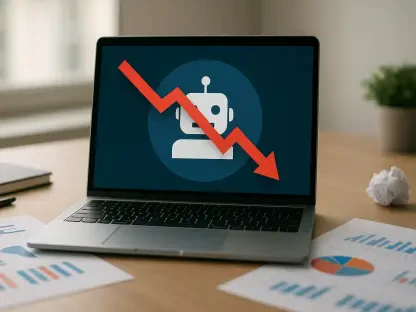

The visceral fear of replacement has transitioned from a fringe concern of the manufacturing sector to a central, destabilizing force within the professional American office environment. As organizations accelerate the integration of generative intelligence and automated workflows, the modern workforce is grappling with a profound psychological shift that fundamentally alters their commitment to professional excellence. Data from the first half of 2026 reveals a startling reality where AI has been cited as the primary driver for more than 101,000 job cuts, a figure that represents a massive escalation in labor market volatility. This quantifiable surge in displacement has created a ripple effect of anxiety that extends far beyond those currently facing unemployment, reaching deep into the cubicles of those still on the payroll. Many high performers now believe the traditional incentive of hard work has lost its intrinsic value, as the perceived inevitability of technological substitution makes even the most dedicated contributions seem futile. Consequently, there is a direct and growing correlation between this technological anxiety and a widespread surge in workplace disengagement, effectively reshaping the employer-employee dynamic into one defined by suspicion rather than mutual growth.
The Historical Erosion of Corporate Loyalty
The foundation of today’s pervasive distrust was not built overnight; it is the culmination of a forty-year shift in management philosophy that began in the 1980s. During that era, American corporations pivoted toward a model that prioritized immediate shareholder interests over long-term employee retention, effectively ending the social contract of lifetime employment. This transition replaced the traditional bond of loyalty with a purely transactional relationship where an individual’s security was tethered exclusively to their immediate utility. As a result, the current rapid expansion of AI is entering a professional landscape where workers are already conditioned by history to expect that their dedication will not be reciprocated. When employees observe that decades of institutional knowledge can be marginalized by a software update, the internal logic of “going the extra mile” collapses. This historical context is essential to understanding why the current technological transition is met with such profound skepticism, as workers view AI not just as a tool for efficiency, but as the final instrument in the complete commodification of human labor.
Behavioral scientists suggest that the current withdrawal of effort acts as a rational self-protection mechanism in response to a broken psychological contract. This unwritten agreement—the belief that consistent dedication will be rewarded with long-term stability—has been the primary driver of productivity in the American economy for generations. However, when the threat of automation becomes a constant background noise, employees naturally begin to conserve their emotional and professional energy to protect their personal well-being. This conservation of effort is not a sign of laziness but a calculated response to a workplace where the returns on hard work are no longer guaranteed. By reducing their emotional investment, workers are attempting to mitigate the psychological trauma that accompanies a sudden layoff. This shift suggests that the decline in output currently observed across several sectors is a direct consequence of a workforce that feels its loyalty has been devalued. The resulting environment is one where the “human capital” of a company is physically present but psychologically detached, waiting for a technological axe that feels increasingly inevitable.
The Rise of Job Hugging and Quiet Quitting
The current labor market presents a deceptive picture of stability, characterized by resignation rates hitting decade-long lows, yet this trend is driven more by fear than by genuine employee satisfaction. This phenomenon, frequently described as “job hugging,” involves workers clinging to their current positions not because they are engaged, but because they fear the external employment prospects in an AI-dominated economy. Nearly half of the modern workforce reports staying in their roles solely out of necessity, creating a demographic of employees who are essentially trapped by economic uncertainty. While on the surface this looks like high retention, it masks a deeper crisis of morale and productivity, as these workers are often the most likely to experience high levels of stress and resentment. The fear of being unable to find a comparable role in an automated market prevents them from seeking better opportunities, leading to a stagnant talent pool where creativity is replaced by a survivalist mindset that prioritizes safety over innovation.
Parallel to the trend of job hugging is the continued normalization of quiet quitting, which has now reached a point where over half of American workers report doing only the bare minimum required to keep their jobs. This lack of engagement is particularly acute among those who feel their roles are at high risk for automation, where disengagement rates frequently climb toward 70%. The mere threat of AI implementation creates a toxic atmosphere that increases cortisol levels and reduces cognitive function, even in organizations that have not yet announced official staff reductions. Workers are increasingly adopting a “salary harvesting” approach, where the goal is to extract the maximum possible compensation while providing the minimum possible effort until their role is eventually phased out. This creates a cycle of diminishing returns for employers, who find themselves paying full salaries for a fraction of the productive output. The emotional toll of this perpetual uncertainty cannot be overstated, as the majority of the workforce now operates under a cloud of constant professional dread that stifles any sense of collective purpose.
AI as a Budgetary Catalyst for Workforce Reduction
A critical nuance in the current labor landscape is that artificial intelligence is frequently utilized as a budgetary catalyst rather than a functional replacement for specific human tasks. Many organizations are not necessarily finding that software can perform an employee’s job better, but rather they are choosing to reduce headcounts to reallocate capital toward the massive costs of AI infrastructure and compute power. This means that workers in roles that are functionally difficult to automate still face a significant risk of being laid off simply to fund the technological transitions occurring in other departments. This financial strategy makes all employees feel expendable, regardless of their specific skill sets or the complexity of their daily responsibilities. When people realize that their employment is being sacrificed to pay for the very technology meant to replace them, the resulting blow to organizational culture is often irreparable. This shift from labor-intensive to capital-intensive business models has created a climate where workers feel they are competing for resources against an inanimate, high-cost digital rival.
This perceived expendability has led to a collapse in the traditional hierarchy of job security, where even specialized white-collar roles are no longer seen as safe havens from market volatility. Previously, high-skill professionals believed that their expertise provided a shield against economic downturns, but the broad capabilities of modern generative systems have shattered this illusion. As companies prioritize the acquisition of automation capabilities, the message being sent to the workforce is that human ingenuity is a secondary concern compared to algorithmic efficiency. This realization has led to a total breakdown of the aspirational nature of many career paths, as workers no longer see a clear trajectory for growth or long-term stability. The result is a workforce that is deeply cynical about corporate messaging regarding “innovation” and “digital transformation,” viewing these terms as euphemisms for the systematic reduction of the human element. The tension between the need for technological advancement and the necessity of a motivated workforce has never been more pronounced, creating a fundamental challenge for the future of organizational management.
Rebuilding Trust Through Mattering and Transparency
Despite the prevailing sense of professional gloom, research indicates that the damage to employee engagement can be partially mitigated through a renewed focus on transparency and a sense of mattering. Organizations that fostered an environment where individuals felt genuinely valued and heard were significantly more likely to maintain a productive and motivated team during these transitions. Leadership teams that prioritized honest, frequent communication about AI implementation plans and the realities of the market helped to reduce the heavy psychological weight of uncertainty that otherwise paralyzed their staff. When workers were treated as partners in the transition rather than as obstacles to be removed, their levels of anxiety decreased, and their willingness to adapt to new tools increased. This approach required a shift away from top-down directives and toward a more collaborative model of corporate evolution. The most successful firms were those that could clearly articulate the continued relevance of their human employees in a world of increasing automation, providing a sense of purpose that transcended simple task completion.
The most effective organizations recognized that the solution to AI-driven disengagement was fundamentally relational rather than technological. Employers who addressed layoff anxiety with genuine empathy and treated their staff with dignity during periods of transition were the ones who retained a committed and resilient workforce. They invested in retraining programs that focused on uniquely human skills—such as complex problem solving, high-level strategy, and interpersonal leadership—which reinforced the idea that technology was an enhancer of human capability rather than a total replacement. By shifting the focus from “efficiency at all costs” to “sustainable productivity,” these leaders ensured that their organizational culture remained intact despite the external pressures of the mid-2020s. Ultimately, the long-term productivity of any enterprise remained tethered to the motivation and psychological well-being of its people. Prioritizing the human element proved to be the only reliable way to prevent a total breakdown of the professional environment and to navigate the complexities of a rapidly changing economic landscape.