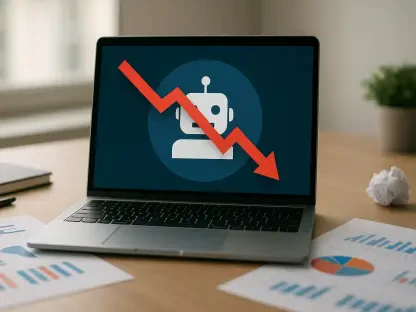

The sudden ubiquity of generative artificial intelligence across corporate environments has created a paradoxical landscape where promised efficiencies are frequently overshadowed by a profound sense of cognitive exhaustion. Recent surveys from mental health organizations indicate that approximately seventy percent of full-time employees have witnessed a significant surge in AI tool adoption within their daily workflows over the course of late 2025 and 2026. This technological acceleration has forced a dramatic shift in how individuals process information, leading to a condition known as emotional detachment for over fifty percent of the demographic. While the initial promise of these tools centered on the reduction of mundane tasks, the reality has manifested as an increase in the complexity and volume of work, forcing many to sacrifice essential rest. Current data suggests that more than half of the workforce is now losing sleep to keep pace with automated systems, signaling an unprecedented mental strain that demands immediate institutional attention. The psychological toll of maintaining constant synchronicity with high-speed algorithmic outputs has pushed the human brain beyond its traditional limits, resulting in a persistent state of high-alert fatigue.
Shifting Paradigms: From Episodic Stress to Chronic Strain
Organizational psychologists have observed that the nature of workplace stress has undergone a fundamental transformation, moving away from temporary, project-based spikes toward a permanent state of chronic pressure. The human brain is not evolutionarily designed to operate in a continuous cycle of high-speed adaptation, yet the rapid evolution of digital ecosystems necessitates just that. Experts such as Jenna Glover have highlighted that the constant need to learn new interfaces while simultaneously managing higher output expectations creates a cognitive bottleneck. This persistent demand for mental agility without adequate recovery periods leads to a breakdown in emotional regulation and decision-making capabilities. In the current 2026 labor market, the cost of this digital friction is becoming visible through rising healthcare expenditures and a noticeable dip in employee retention rates. Organizations that fail to recognize the limits of human neurobiology risk undermining the very productivity gains they sought to achieve through their multi-million dollar technological investments in automated systems.
The mental fatigue currently permeating the professional sphere is more than just a byproduct of a busy schedule; it represents a systemic failure to balance human capacity with technological speed. When employees feel they must compete with or manage a machine that never tires, they often default to a survivalist mindset that prioritizes immediate task completion over long-term strategic thinking. This shift is particularly evident in middle management, where the responsibility of translating AI-generated insights into actionable business outcomes has created a unique form of “management burnout.” The detachment reported by workers is often a defense mechanism against a work environment that feels increasingly alien and relentless. Without a structured approach to “inoculating” the workforce against this uncertainty, the psychological impact of these tools could lead to a permanent degradation of the creative and empathetic skills that remain uniquely human. This crisis suggests that the most critical infrastructure for the modern company is not the software stack itself, but the cognitive health of the people who operate and oversee it.
Strategic Solutions: Building a Sustainable Technological Future
Addressing the mental health implications of modern technology requires a shift from reactive wellness programs to “upstream” interventions that build foundational cognitive resilience. Rather than offering traditional stress-management seminars after burnout has occurred, forward-thinking Human Resources departments are now focusing on teaching employees skills such as attention control and emotion regulation. This approach involves training the workforce to navigate the constant distractions and rapid shifts inherent in a highly automated environment. By fostering cognitive flexibility, companies enable their staff to view technological change as a manageable evolution rather than a direct threat to their professional identity or well-being. Furthermore, integrating resiliency goals directly into performance metrics ensures that mental sustainability becomes a core business objective. This cultural shift acknowledges that a high-performing employee in 2026 must be as adept at managing their own mental energy as they are at utilizing the latest predictive analytics software or large language models to complete their assignments.
The integration of structural “cognitive release valves” proved to be a vital strategy for organizations seeking to mitigate the long-term effects of digital strain. Companies that implemented policies such as “Focus Fridays,” which restricted all non-essential meetings, provided the mental space necessary for deep work and psychological recovery. Managers successfully incorporated self-care and resilience tracking into their annual reviews, shifting the focus from purely quantitative metrics to a more holistic view of human performance. These proactive measures treated employee health as a maintenance requirement similar to the routine servicing of physical machinery. By prioritizing human sustainability, leadership teams secured a more stable and innovative workforce capable of leveraging advanced tools without succumbing to chronic exhaustion. The most effective businesses recognized that the path forward necessitated a balanced partnership between human intuition and machine efficiency. They invested in the psychological infrastructure required to turn technological potential into sustainable success, ultimately ensuring that the workforce remained healthy and focused in an increasingly complex and automated world.