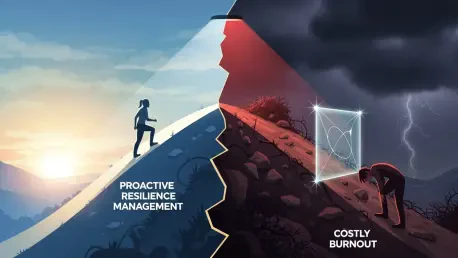

The silent fracture of a high-performing team often begins long before the first resignation letter surfaces, manifesting in subtle shifts in tone, delayed responses, and a gradual thinning of cognitive bandwidth. When an organization waits for visible signs of distress to emerge, it has already lost the battle for productivity and engagement. Business leaders frequently overlook the months of diminishing returns that precede a total breakdown, failing to account for the heavy financial toll of a workforce operating at a fraction of its potential.
Why Waiting for Burnout Is the Most Expensive Strategy a Company Can Have
Relying on a crisis as the primary signal for intervention is a high-stakes gamble with human capital. Most managers only notice a problem when absenteeism spikes or a key contributor leaves, but the financial damage accumulates long before these events. In reality, the slow erosion of focus and morale drains resources through “quiet quitting” and decreased efficiency, costing companies billions in untapped value.
When an organization treats exhaustion as a sudden occurrence rather than a slow, predictable descent, it inherits the massive expenses associated with recruitment, retraining, and lost institutional knowledge. Proactive leaders recognize that the cost of preventing a burnout event is a fraction of the price paid for replacing an experienced employee. This financial reality shifts the conversation from occasional wellness perks to a fundamental requirement for operational continuity.
The Shift from Lagging Indicators to Proactive Workforce Stability
Traditional performance management systems are fundamentally flawed because they depend on lagging indicators like turnover rates and annual survey results. In a fast-paced environment characterized by rapid technological shifts and constant digital connectivity, these retrospective snapshots are insufficient. They describe what has already happened rather than what is currently occurring within the psychological infrastructure of the team.
Modern workforce stability requires a move toward real-time assessment that distinguishes between basic well-being and true operational resilience. While wellness programs might offer temporary relief, resilience management focuses on the ability to absorb pressure and maintain high performance during periods of intense change. Companies that successfully navigate economic uncertainty are those that have swapped subjective guesswork for objective, continuous monitoring of their teams’ capacity to adapt.
Deconstructing the Gradual Erosion of Human Capacity
Capacity is not a fixed attribute but a fluctuating resource that resembles a rechargeable battery. When the demands of digital intensity and financial stress are layered upon a standard workload without sufficient recovery time, the battery begins to lose its ability to hold a charge. This erosion is rarely caused by a single stressful project; instead, it is the cumulative result of unmanaged stressors that intersect and amplify one another.
By identifying how these various pressures overlap, organizations can develop more precise strategies to protect their employees. For instance, high digital workloads become far more damaging when coupled with personal financial uncertainty or a lack of clear communication from leadership. Understanding these intersections allows for the transition away from generic corporate wellness and toward a targeted management of human energy and cognitive resources.
Analyzing Resilience Volatility Through the Lens of the Resilience Report
Recent data involving over 3,000 employees illustrates a significant shift in the internal stability of the modern workforce. While general resilience levels have shown a modest dip of 6%, the volatility of that resilience has surged by 50%. This surge indicates that employees are no longer just tired; they are experiencing sharp, unpredictable fluctuations in their ability to handle pressure, which introduces a new layer of risk to critical business operations.
This increased volatility suggests that even high performers are closer to their breaking points than they appear on the surface. As digital workloads become denser and the margin for error shrinks, the unpredictability of human performance becomes a major liability for high-stakes projects. Leaders must begin to treat resilience as a core business metric, much like cash flow or supply chain reliability, to ensure that the organization remains agile under pressure.
Building an Operational Framework for Real-Time Resilience Management
To move beyond the cycle of reactive damage control, organizations implemented data-led frameworks that utilized anonymized behavioral insights to identify pressure points before they reached a tipping point. This transition allowed employees to self-manage stressors through private, holistic tools while providing leadership with the high-level risk assessments necessary to adjust workloads. By translating human capacity into measurable financial exposure, companies were able to create a stable environment where pressure was managed through visibility.
The shift toward a proactive stance ultimately redefined how companies approached human capital. Leaders who prioritized continuous monitoring and early recovery strategies found themselves better equipped to handle the complexities of the current economy. This evolution in management ensured that workforce dynamics no longer functioned as a hidden drain on the bottom line, but as a robust foundation for long-term organizational health and sustainable growth.