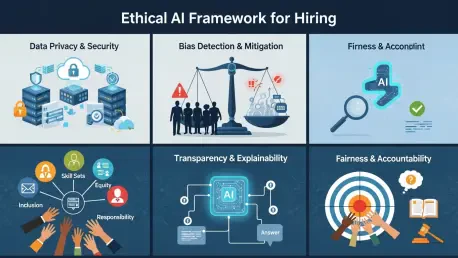

The traditional recruitment landscape is currently undergoing a radical transformation as the unchecked proliferation of automated screening tools has created a digital wall between talent and opportunity, often leading to a significant erosion of trust. While many enterprises rushed to adopt large language models to manage the sheer volume of applications, the unintended consequences have manifested as opaque decision-making processes and a palpable sense of frustration among job seekers. This friction highlights a critical need for a more disciplined approach to technological integration in human resources. To address these systemic challenges, Greenhouse has unveiled a comprehensive Ethical AI Framework designed to restore transparency and ensure that automation serves as an assistant rather than a replacement for human judgment. By shifting the focus from mere efficiency to “responsible innovation,” the platform aims to bridge the gap between high-speed processing and the nuanced evaluation required for effective hiring. This strategic move signals a departure from the “black-box” methodology that has characterized much of the recent tech adoption in the sector, prioritizing a structure where every automated output remains interpretable and grounded in objective, role-relevant data.
Beyond simple automation, the framework is architected around the concept of structured hiring, which serves as a vital safeguard against the erratic patterns often found in unsupervised machine learning. In many contemporary systems, algorithms might inadvertently penalize a candidate for a gap in employment or a specific phrasing that has no bearing on their ability to perform the job duties effectively. Greenhouse’s approach counters this by mandating that AI evaluations are strictly tied to predefined, role-specific signals and competencies. This ensures that the technology remains focused on meritocratic indicators rather than superficial data clusters that could mirror historical societal biases. By tethering the AI’s logic to a rigid set of hiring criteria, organizations can maintain a high degree of consistency across thousands of applications, ensuring that every individual is measured against the same professional yardstick. This methodology essentially transforms the AI from a wandering scout into a disciplined researcher that only looks for specific, validated evidence of a candidate’s potential success within a defined corporate environment.
Establishing Foundational Pillars for Responsible Automation
At the heart of this new initiative lies a reimagined workflow that seeks to surface deep insights and complex patterns that were previously invisible to manual recruiters. While a human might struggle to synthesize data points from hundreds of diverse resumes simultaneously, the integrated AI tools are designed to identify subtle correlations between a candidate’s historical achievements and the specific needs of a modern department. However, this is not a hands-off process; the framework insists that these insights remain grounded in human experience to prevent the “de-skilling” of the recruitment profession. The primary objective is to reduce the overwhelming cognitive load on hiring teams—such as the tedious task of manual scheduling or initial data sorting—while enforcing a mandatory stage for deliberate human review. This ensures that while the machine provides the map and the data points, a person still drives the final decision-making process. By automating the high-volume, low-value tasks, the technology frees up human professionals to focus on cultural alignment and complex interpersonal assessments that algorithms cannot replicate.
Furthermore, the framework introduces the concept of explicit decision ownership, a radical shift toward accountability in an era where software often makes silent determinations. Every outcome generated or influenced by the AI must be traceable to a specific human intent or a recorded managerial action, ensuring that “the computer said so” is never an acceptable justification for a hiring outcome. This transparency is bolstered by a non-negotiable requirement for explainability, meaning that any suggestion or summary provided by the system must be accompanied by a clear, interpretable rationale. If a recruiter asks why a specific candidate was highlighted, the system must be able to point to specific skills, experiences, or responses that triggered the recommendation. This level of clarity prevents the drift toward biased or illogical screening results that can occur when systems are left to optimize for efficiency alone. By maintaining this strict audit trail, the platform provides a dual benefit: it protects the rights of the candidate while offering the organization a defensible and logical basis for its talent acquisition strategies.
Securing Data Integrity and Global Compliance Standards
To navigate the increasingly complex regulatory environment of the late 2020s, the framework places a heavy emphasis on data privacy and rigorous security protocols. Greenhouse has distinguished itself by securing the ISO 42001 certification, which represents the premier international standard for artificial intelligence governance and risk management. This certification is not merely a badge of honor but a commitment to a continuous cycle of internal and external monitoring to ensure the technology operates within ethical boundaries. Crucially, the company has implemented a strict policy regarding the training of its large language models, explicitly stating that personal customer data is never used to refine these algorithms. This “privacy-first” architecture prevents the leakage of sensitive corporate information and ensures that the AI’s learning process remains isolated from the proprietary data of individual clients. Such a measure is essential for maintaining the integrity of the recruitment process and fostering long-term trust between the platform provider and the diverse enterprises that rely on its services for daily operations.
In addition to standard security measures, the framework introduces a localized approach to fairness through independent monthly bias audits conducted across ten different protected classes. Rather than relying on a single, yearly review, these frequent assessments allow the system to catch and correct emerging biases before they can impact a significant number of applicants. The platform also rejects the use of arbitrary composite scores, which often hide the “why” behind a candidate’s ranking in favor of a single, misleading number. Instead, candidates are organized into discrete categories backed by qualitative and quantitative explanations that recruiters can easily digest. This granular approach allows for a more nuanced understanding of talent, recognizing that a person might be a “top match” for technical skills while requiring more development in leadership areas. By providing a multidimensional view of every applicant, the technology encourages hiring managers to look past a simple “yes” or “no” and consider the holistic value an individual might bring to the broader organizational ecosystem.
Future Considerations for Human Centric Talent Acquisition
Organizations looking to implement these ethical standards should begin by conducting a comprehensive audit of their current automated tools to identify any “black-box” systems that lack clear explainability. The transition to a more transparent model requires a shift in mindset from seeing AI as a cost-cutting tool to viewing it as a precision instrument for quality control. It was essential for Greenhouse to provide customers with the ability to toggle specific AI features on or off, and this level of granular control should be a requirement for any enterprise-grade software. This allows companies to pilot new technologies in a controlled environment before full-scale deployment. Furthermore, establishing a clear pathway for candidates to request manual reviews of automated decisions proved to be a critical step in maintaining brand reputation and legal compliance. By empowering the applicant and the recruiter alike, firms can cultivate a hiring culture that values human agency and treats technology as a supportive framework rather than an invisible gatekeeper that operates without oversight.
The shift toward this ethical paradigm also necessitates a renewed focus on training hiring teams to interpret AI-generated insights with a critical and informed eye. Rather than accepting the machine’s summary as absolute truth, recruiters must learn to use these outputs as a starting point for deeper investigation during the interview process. This symbiotic relationship between human intuition and machine efficiency represents the most viable path forward for the industry. Successful implementation involved moving away from the pursuit of “perfect” algorithms toward the development of “accountable” systems that admit their limitations. By prioritizing transparency and traceability, organizations did more than just improve their hiring metrics; they reinforced the fundamental principle that recruitment is, at its core, a human endeavor. As we move further into this decade, the organizations that thrived were those that balanced technological sophistication with a steadfast commitment to fairness and the preservation of the human element in every single hiring interaction.